Adult Orthodontics: Why Straight Teeth Are Only Part of the Story
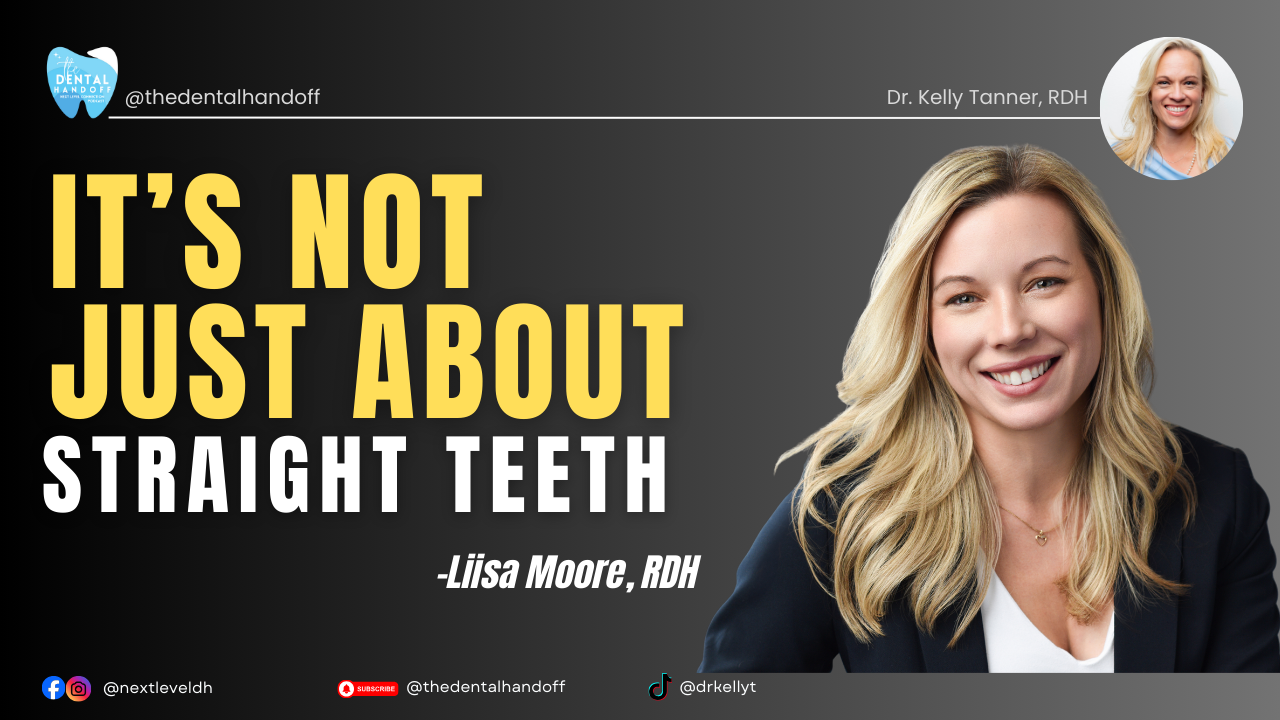
If there’s one message I hope dental professionals and patients alike take to heart, it’s this: orthodontics is not just about straight teeth. It’s about function. It’s about protection. And ultimately, it’s about long-term oral and systemic health.
On a recent episode of The Dental Handoff, I sat down with one of my favorite humans and a true orthodontic expert—Liisa Moore, RDH, who teaches at the college level in Canada and practices full-time in an orthodontic office. What unfolded was an honest, clinically rich conversation about adult orthodontics, bias in recommendations, and why we can no longer afford to view orthodontic care as “just cosmetic.”
The Rise Of The Adult Orthodontic Patient
More adults than ever are pursuing orthodontic treatment and for good reasons. As Liisa shared, many adult patients begin treatment after their children finish orthodontics. Others finally have insurance coverage, financial flexibility, or access to more aesthetic options, such as clear aligners and ceramic brackets.
But what’s fascinating is how often adult orthodontic treatment starts as an aesthetic goal and evolves into something much bigger.
Patients often say:
“My teeth feel better.”
“I can chew more comfortably.”
“Food doesn’t get stuck anymore.”
“Flossing is finally easy.”
That’s not cosmetic. That’s function.
Straight Teeth Do Not Always Equal Healthy Teeth
One of the biggest misconceptions in dentistry is that straight-looking teeth are healthy. Clinically, we know that’s not always true.
Crowding, malalignment, and traumatic occlusion contribute to:
Chipping and cracking
Tooth wear
Food impaction
Increased calculus buildup
Bone loss
These issues don’t happen overnight. They develop gradually often over decades until one day the patient presents with sensitivity, pain, or a fracture.
At that point, the “magic eight ball” becomes very predictable:
bonding → crown → root canal → extraction → implant. Orthodontics can interrupt that path.
Recession Is Rarely Just “Brushing Too Hard”
Many patients and unfortunately some clinicians still attribute recession primarily to toothbrush abrasion. While that can play a role, isolated recession is far more often linked to occlusal trauma and tooth position.
When teeth are misaligned, forces are unevenly distributed. Certain teeth take on excessive load, leading to:
Bone loss (which cannot be regenerated)
Root exposure
Increased caries risk
Sensitivity and inflammation
This is where orthodontics becomes a preventive intervention, not just an aesthetic one.
Using Technology To Educate, Not Sell
One of the most powerful tools we discussed is the iTero occlusogram a visual heat map that shows pressure points and occlusal load. When patients can see where excessive force exists, conversations become clearer, faster, and more impactful.
This isn’t about telling patients what to do. It’s about presenting risk factors and enabling informed decisions.
Even without iTero, intraoral cameras, and digital photography can:
Highlight recession progression
Show wear facets and fractures
Make “one millimeter” visible and meaningful
Education changes everything.
Bias Has No Place In Clinical Recommendations
One of the most important themes in this conversation was bias and how often it quietly influences our recommendations.
We assume:
Patients are “too old” for orthodontics
They won’t be interested
They can’t afford it
They don’t care about their smile
None of those assumptions are ours to make.
Liisa shared cases of patients in their 60s, 70s, and even 80s who successfully completed orthodontic treatment. Age is not the barrier bone health, periodontal stability, and overall health are what matter.
Our responsibility is simple:
Identify risk
Explain consequences
Present options
Then step back and let the patient decide.
Orthodontics Is Customized Care
Another powerful reminder: orthodontic treatment is not one-size-fits-all.
Some patients:
Want to keep a diastema because it’s part of their identity
Have implants that must be worked around
Only need treatment in one arch
Choose brackets over aligners—or vice versa
Orthodontics today is individualized, thoughtful, and flexible. The goal isn’t perfection it’s protection and stability.
The Role of the Hygienist In Adult Orthodontics
As hygienists, we are uniquely positioned to:
Identify early signs of occlusal trauma
Recognize recession patterns
Discuss long-term risk
Encourage preventive solutions
Reinforce patients who choose orthodontic care
We are not selling. We are educating. And often, we are the first voice that plants the seed.
Why Adult Orthodontics Is An Investment, Not A Cost
Yes orthodontics is an investment. But so are crowns, implants, grafting, and restorative rehabilitation.
When patients understand that orthodontics can:
Reduce future restorative needs
Preserve bone and tooth structure
Improve hygiene access
Enhance comfort and function
They begin to see value—not just price.
The Takeaway
Orthodontics isn’t just for kids.
And it’s never just about straight teeth.
It’s about:
Function
Protection
Risk reduction
Long-term oral health
Patient-centered decision-making
Our job is to educate without bias, use the tools we have, and trust patients to make choices when they truly understand what’s at stake.
That’s how we elevate care—and dentistry as a whole.
Watch the full episode here: https://youtu.be/Ldc5jBSKhT8
Keywords: adult orthodontics, orthodontics for adults, clear aligners, braces for adults, dental hygiene and orthodontics, occlusal trauma, gingival recession, abfraction lesions, tooth wear and misalignment, dental crowding, traumatic occlusion, iTero occlusogram, intraoral camera dentistry, preventive orthodontics, functional orthodontics, orthodontic consultation, dental hygienist education, patient education in dentistry, orthodontic treatment planning, customized orthodontic care, oral health and orthodontics, long-term dental health, dental hygiene risk assessment, Kelly Tanner, PhD, RDH, The Dental Handoff podcast